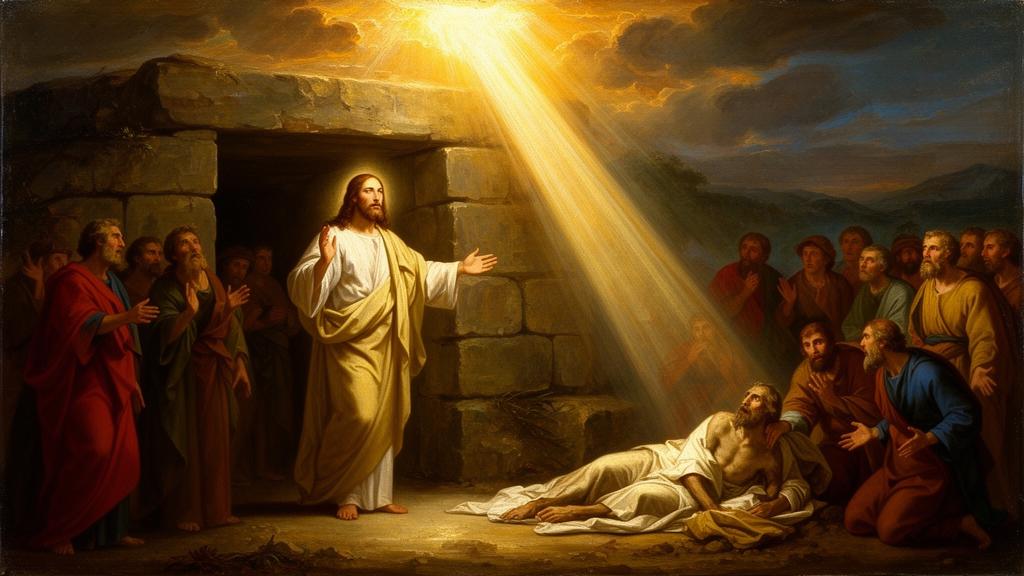
Raising Lazarus from the Dead
Primary Reference: John 11:1-44
Lazarus of Bethany, the brother of Mary and Martha and a dear friend of Jesus, fell gravely ill. The sisters sent word to Jesus, but He intentionally delayed two days before traveling to Bethany. When He arrived, Lazarus had been dead and entombed for four days. Martha met Jesus on the road and declared, "Lord, if thou hadst been here, my brother had not died." Jesus responded with one of the most powerful declarations in all of Scripture: "I am the resurrection, and the life: he that believeth in me, though he were dead, yet shall he live."
At the tomb, Jesus was deeply moved — the Greek describes a groan of indignation against the ravages of death itself. Then came the shortest and one of the most profound verses in the Bible: "Jesus wept." The Son of God, who knew He was about to raise Lazarus, still wept at the tomb. His tears were not for Lazarus but for the devastation that death inflicts upon humanity — the consequence of sin that He had come to destroy. He commanded the stone to be removed, prayed aloud to the Father, and then cried with a loud voice: "Lazarus, come forth!"
The dead man came out, bound in grave clothes, and Jesus said, "Loose him, and let him go." A man four days dead — already decomposing, as Martha had warned — walked out of the tomb at the command of Christ. This was Jesus' greatest miracle before His own resurrection, and it directly precipitated the plot to kill Him. The religious leaders recognized that if Jesus could raise the dead, they could not contain His influence. Ironically, by plotting His death, they set in motion the very events that would lead to the greatest resurrection of all. The raising of Lazarus is the definitive demonstration that Jesus Christ is Lord over death, and that all who believe in Him, though they die, shall live.
Scripture References
John 11:1-44
The full account of Jesus raising Lazarus from the dead after four days.
John 11:25-26
"I am the resurrection, and the life" — Jesus' supreme declaration of deity and power over death.
John 11:35
"Jesus wept" — the Son of God's compassion at the devastation of death.
Ezekiel 37:1-14
The valley of dry bones — God's promise to raise His people from death, previewed in Lazarus.
Isaiah 26:19
"Thy dead men shall live, together with my dead body shall they arise" — the resurrection hope.
Daniel 12:2
"Many of them that sleep in the dust of the earth shall awake" — the promise of bodily resurrection.
Job 19:25-26
"I know that my redeemer liveth... yet in my flesh shall I see God" — the ancient hope of resurrection.
1 Corinthians 15:54-55
"Death is swallowed up in victory. O death, where is thy sting?" — the triumph inaugurated at Lazarus' tomb.
Romans 8:11
"He that raised up Christ from the dead shall also quicken your mortal bodies" — resurrection power for all believers.
John 5:28-29
"All that are in the graves shall hear his voice, and shall come forth" — the future fulfillment Lazarus previewed.