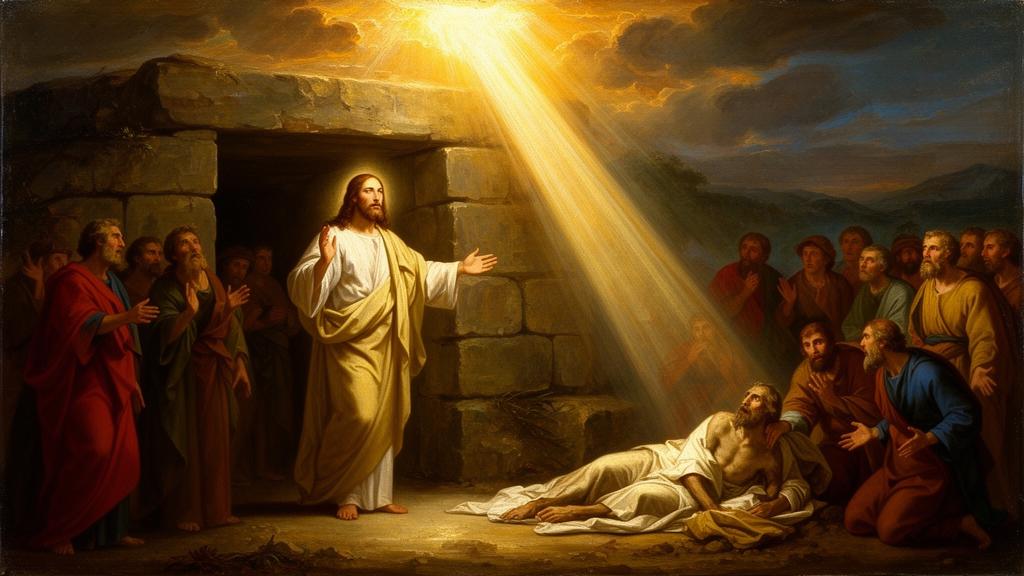
Raising the Widow's Son at Nain
Primary Reference: Luke 7:11-17
As Jesus approached the gate of the town of Nain, He encountered a funeral procession. A dead man was being carried out — the only son of a widow. In the ancient world, a widow who lost her only son lost not only her child but her sole source of financial support and social standing. She faced destitution and utter despair. A large crowd from the town was with her, mourning this devastating loss.
When Jesus saw her, He was moved with compassion — the Greek word splanchnizomai, describing a gut-wrenching, visceral response to human suffering. Without being asked, without any expression of faith from the widow, Jesus acted purely from His own heart of mercy. He said to her, "Weep not," then touched the bier — the open coffin — causing the bearers to halt. He spoke to the dead man: "Young man, I say unto thee, Arise." The dead man sat up and began to speak, and Jesus presented him to his mother.
Fear seized the entire crowd, and they glorified God, saying, "A great prophet is risen up among us" and "God hath visited his people." Their words echoed the Old Testament, recalling Elijah's raising of the widow's son at Zarephath. But Jesus performed this miracle with even greater authority than Elijah — the prophet had lain upon the child and prayed repeatedly, while Jesus simply spoke a command. The people recognized that in Jesus, God Himself had visited His people, just as the prophets had foretold. This miracle demonstrates that Christ's compassion is not dependent on human faith — He is moved by suffering itself and acts from the depths of His own love.
Scripture References
Luke 7:11-17
The sole account of Jesus raising the widow's son at Nain from the dead.
1 Kings 17:17-24
Elijah raising the widow of Zarephath's son — the Old Testament parallel Jesus surpassed.
Luke 7:16
"God hath visited his people" — the crowd's recognition of divine visitation in Christ.
Deuteronomy 10:18
"He doth execute the judgment of the fatherless and widow" — God's special care for the vulnerable.
Psalm 68:5
"A father of the fatherless, and a judge of the widows, is God in his holy habitation."
Isaiah 25:8
"He will swallow up death in victory; and the Lord GOD will wipe away tears from off all faces."
Psalm 116:15
"Precious in the sight of the LORD is the death of his saints" — God's tender care over death.
Zechariah 9:9
"Behold, thy King cometh unto thee" — the divine visitation the crowd proclaimed.
James 1:27
"Pure religion... is this, to visit the fatherless and widows in their affliction."
Revelation 21:4
"God shall wipe away all tears from their eyes; and there shall be no more death" — the ultimate fulfillment.