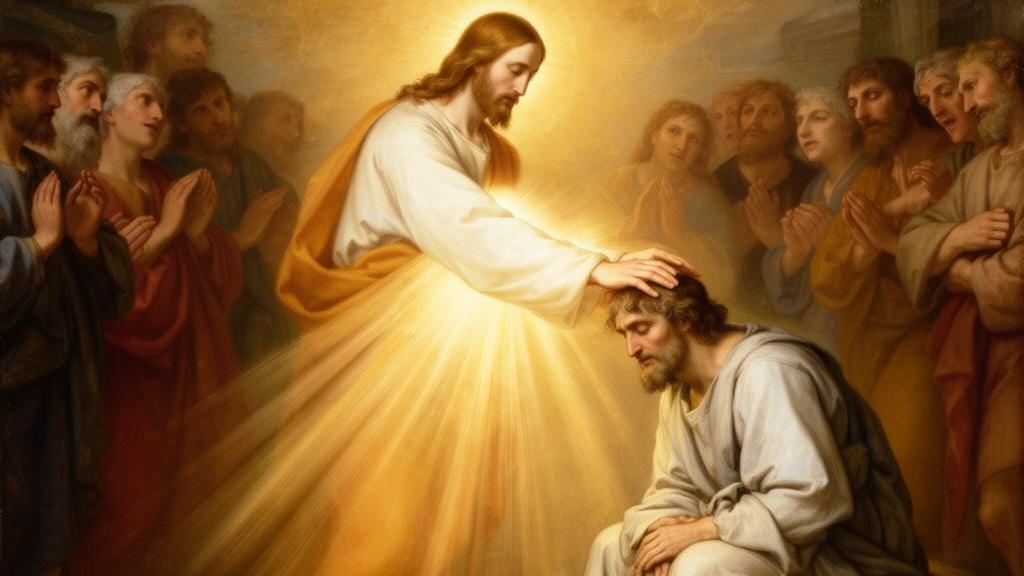
Healing Malchus's Ear
Primary Reference: Luke 22:50-51
In the Garden of Gethsemane, as the armed mob came to arrest Jesus, Simon Peter drew his sword and struck the high priest's servant, cutting off his right ear. John's Gospel identifies the servant as Malchus. In the most volatile moment of His earthly ministry — facing betrayal, arrest, and the cross — Jesus demonstrated His character one final time through an act of healing mercy toward His enemy.
Jesus said, "Suffer ye thus far," and touched Malchus's ear and healed him. This was Jesus' last miracle before the crucifixion, and it is profoundly significant that it was an act of compassion toward someone who had come to arrest Him. Even as He submitted to the Father's will and surrendered to death, Jesus continued to heal, restore, and show mercy. He practiced what He preached: "Love your enemies, do good to them which hate you."
This miracle also revealed Jesus' complete sovereignty over the events of His passion. He was not a helpless victim; He could have called twelve legions of angels to His defense. Instead, He chose the cross — and His final healing act proved that He went willingly. By healing the servant of the high priest, Jesus demonstrated that His kingdom is not of this world and does not advance by the sword. Peter's violent act was met with Jesus' gracious healing — violence answered with mercy, hate met with love, a fitting final miracle for the Prince of Peace.
Scripture References
Luke 22:50-51
The primary account of Jesus healing Malchus's ear in Gethsemane.
John 18:10-11
John identifying Peter as the swordsman and Malchus as the servant's name.
Matthew 26:51-54
Jesus declaring He could call twelve legions of angels but chose submission.
Matthew 5:44
"Love your enemies, bless them that curse you" — Jesus practicing His own teaching.
Isaiah 53:7
"He was oppressed, and he was afflicted, yet he opened not his mouth" — the Suffering Servant.
Romans 5:8
"While we were yet sinners, Christ died for us" — love toward enemies demonstrated at the arrest.
1 Peter 2:23
"When he was reviled, reviled not again; when he suffered, he threatened not" — Christ's example.
Isaiah 9:6
"The Prince of Peace" — whose final miracle was an act of peace, not war.
Romans 12:21
"Be not overcome of evil, but overcome evil with good" — the principle Jesus lived out.
John 10:18
"No man taketh my life from me... I lay it down of myself" — Christ's sovereign choice.